

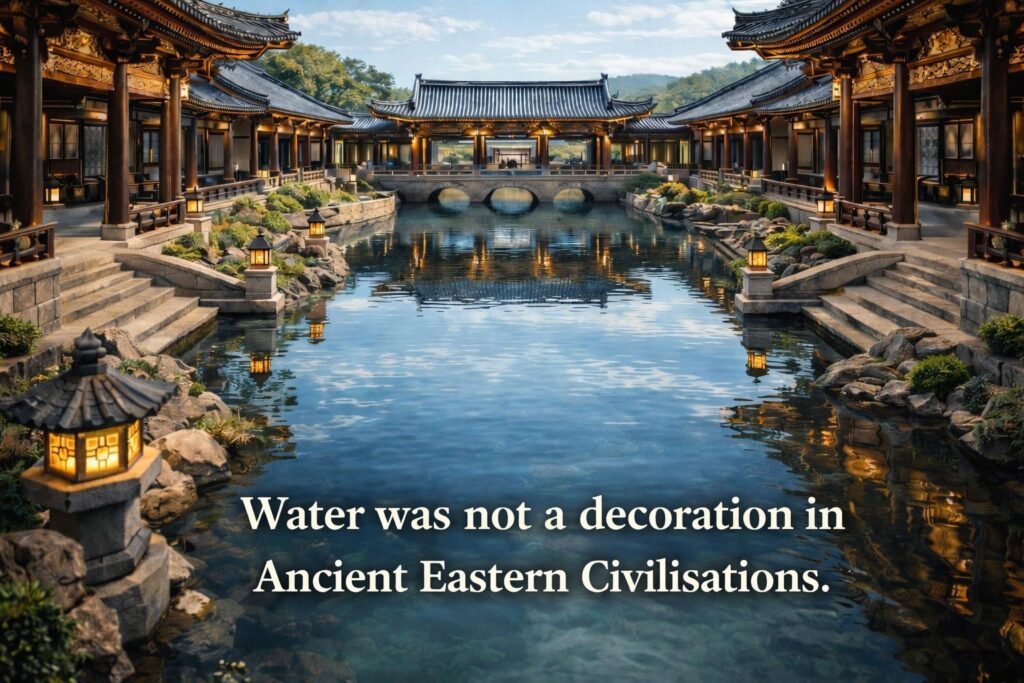
Water was not a decoration in Ancient Eastern Civilisations
How China and Joseon Used Water as Power, Health, and Prosperity Infrastructure
Water in ancient Eastern civilisations like emperial China and Josean (Korea) was never decorative. What appears to be beauty in imperial palaces is a deliberate system. Designed to regulate the human body, stabilize power, and keep prosperity flowing. These cultures built water into daily life for a reason.
And modern cities removed it, at a cost we’re only beginning to measure.
Water was treated as an active force in daily life.
It shaped movement, decision-making, emotional regulation, and the continuity of power across generations.
What appears today as elegance or refinement was, in reality, applied intelligence refined through centuries of observation. Where water flowed through daily life, systems remained coherent longer. Where water was removed, fragmentation accelerated.
Water as Regulator of the Human Nervous System
Ancient Eastern civilisations understood that still and gently moving water entrains the body.
Water slows breath.
It stabilizes emotion.
It softens thought.
This is why palace ponds were placed at eye level rather than hidden away. Why bridges interrupt walking and force a pause. Why long promenades invite rhythm instead of speed.
Fountains inside homes were not luxury features. They functioned as nervous system hygiene. Continuous exposure to water regulated stress responses before they could accumulate.
Governance began in physiology.
A regulated body produces a clearer perception.
Clear perception produces better decisions.
Water as Stabilizer of Authority
Imperial houses were pressure environments. Hierarchy, ambition, secrecy, succession, and suppressed emotion existed within the same confined spaces.
Water acted as a counterweight.
It absorbed excess charge.
It prevented emotional buildup from becoming toxic.
It kept the collective field breathable.
Without water, such systems collapse into paranoia and internal violence much faster. History shows that when water disappeared from palace life, instability followed shortly after.
Water slowed decay from within.
Flow Over Force in City Design
Ancient Eastern civilisations did not attempt to dominate water inside cities.
They braided cities around it.
Rivers ran through capitals.
Canals passed through neighbourhoods.
Water was allowed to move freely, and humans adjusted their structures accordingly.
This reveals a fundamentally different worldview from later dominance-based architecture.
Life moves first.
Power follows.
When water is forced into control, systems fracture. When water is allowed to flow, systems adapt.
Water as Emotional and Memory Buffer
Courtyard ponds in China and Korea were often positioned to receive moonlight, reflections, and sound.
This was not symbolic only.
Water functioned as a buffer for emotional residue. Grief, ambition, fear, celebration, and conflict were absorbed and released through the water rather than stored in the people.
Homes without water accumulate emotional sediment.
Homes with water release it daily.
This is one reason lineage homes protected internal water so carefully. Water preserved continuity not by force, but by release.
Walking Beside Water as Cognitive Integration
Promenades along water were intentional design choices.
Walking beside water synchronizes left and right brain. Thought re-enters the body. Conversation becomes coherent rather than abstract.
Important decisions were discussed while strolling near water, not seated in dry rooms. Movement, combined with water, created an integration between intellect and instinct.
Power was exercised while embodied.
Water as Flow, Prosperity, and Ease of Wealth
One layer is often overlooked.
Ancient Eastern civilisations understood that money behaves like water.
It flows where resistance is low.
It circulates where pathways exist.
It stagnates where systems are rigid.
By embedding water into palace grounds, rulers aligned themselves with circulation itself. Water signalled that resources could move, trade could stabilise, and prosperity could circulate rather than concentrate destructively.
A palace without water is a closed system.
A palace with water is a living economy.
Abundance was not forced. It was allowed.
Practical Intelligence, Not Spiritual Abstraction
These designs were not spiritual in the modern sense.
They were practical.
They emerged from centuries of observing cause and effect. Water present resulted in fewer internal fractures. Water’s absence resulted in faster decay of both people and power.
Civilisations did not collapse because water intelligence was naive. They collapsed when it was forgotten.
Why This Still Matters Today
Modern cities systematically removed water from daily life.
Glass towers replaced courtyards.
Concrete replaced reflection.
Speed replaced rhythm.
At the same time, stress-related illness, anxiety, aggression, and nervous system dysregulation increased. This correlation is no longer speculative. It is measurable.
Contemporary research known as the Blue Mind Theory documents what ancient Eastern civilisations applied architecturally thousands of years ago: proximity to water directly affects human physiology.
Studies referenced within Blue Mind show that people who live within close, regular reach of natural water experience measurable benefits, including:
- Lower blood pressure
- Reduced stress hormone levels
- Slower heart rate
- Improved emotional regulation and cognitive clarity
Several large population studies indicate that these effects are strongest when people live within walking distance of water, typically defined as 300 to 500 meters from a natural water source. At this distance, water becomes part of daily sensory input rather than an occasional destination.
The practical recommendation that follows from this research is clear:
If possible, live within close reach of water.
If not, visit water daily.
Importantly, Blue Mind research does not frame water as symbolic, spiritual, or lifestyle-based. It describes the direct cause-and-effect relationship between water exposure and nervous system regulation.
This is precisely what ancient Eastern civilisations already understood.
Rather than asking people to seek water intentionally, they built water into daily life. Regulation happened continuously. Decision-making, emotional processing, and social coherence were supported passively, simply by living within water-organized environments.
When water leaves daily life, consciousness hardens.
When water remains close, intelligence stays fluid.
What modern research now confirms through data, ancient architects encoded into stone, space, and movement.
Water was not decoration.
It was infrastructure.