Tears, Grief, and the Alchemy of Water
Grief is not only an emotion. It is a process that moves through the body as water. Grief initiates an alchemising process in the body, in which calcified, stuck krystic water becomes fluid again. This blog explores what tears are, how grief transforms the state of the body’s inner water, and why tears have been recognized as sacred across cultures.
What Tears Are
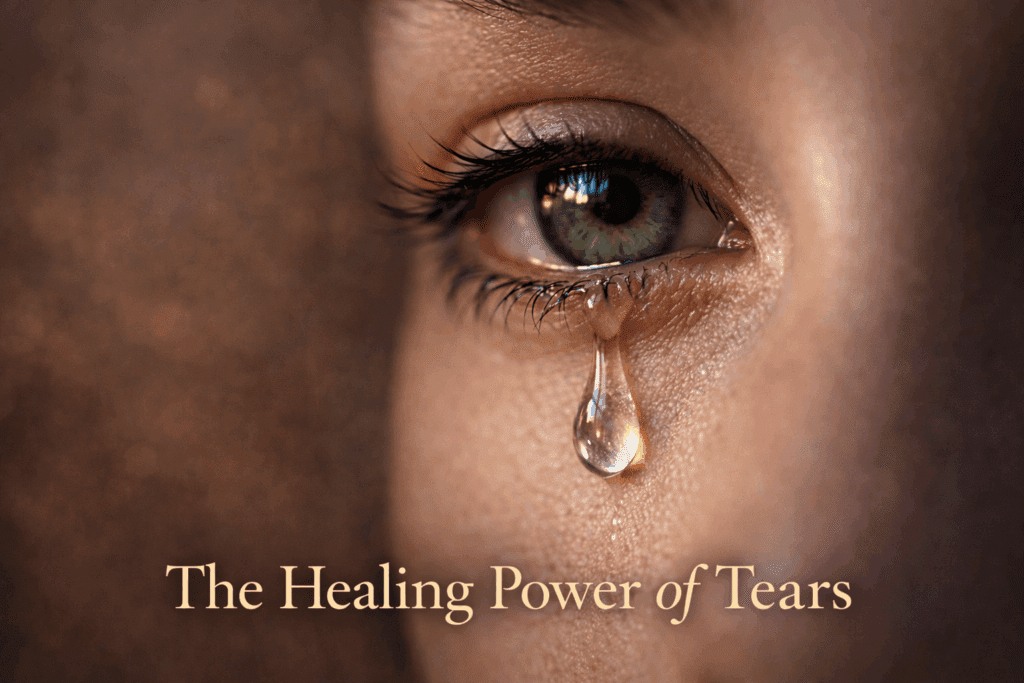
A tear is water that has passed through the body. Not just through the eyes, but through the nervous system, the heart, memory, and meaning.
Tears do not appear randomly. They arise when something matters. When something touches attachment, love, loss, or truth.
This is why tears are different from ordinary water. They are relational water. Water that has been shaped by experience.
When someone cries, the body is not breaking down. It is completing a cycle.
The Three Forms of Tears
The human body produces three distinct types of tears. They are not the same.
- Basal Tears
Basal tears are present at all times. They lubricate the eyes and protect them. They are functional, automatic, and largely unnoticed.
- Reflex Tears
Reflex tears are triggered by irritation. Smoke, onions, dust. They flush the eyes and remove foreign substances.
These tears are protective rather than emotional.
- Emotional Tears
Emotional tears are different. They arise from grief, relief, overwhelm, love, or deep recognition.
These tears carry the imprint of the emotional and nervous system. They contain different concentrations of proteins, hormones, and signalling molecules.
This blog focuses on this third phase. Because emotional tears represent processed experience.
They are not raw emotion. They are emotions that have spread throughout the body.
The Structures Inside a Tear
A tear is not just salt water.
It contains:
- Water as the carrier
- Electrolytes such as sodium and potassium
- Proteins related to the immune response
- Hormonal and neurochemical traces linked to emotional states
Emotional tears differ from reflex tears in their internal composition. They reflect that something has been metabolized.
In this sense, a tear is not waste. It is resolved material.
What Appears When a Tear Dries
When a tear dries, the water evaporates. What remains are salts and proteins that form visible patterns.
Under magnification, dried tears show crystalline structures. Salt-based formations.
These patterns vary with the body’s internal state. Stress, illness, and emotional load alter their structure.
This indicates an important point: tears exhibit a pattern.
The substance of a tear indicates that the body has undergone alchemy. What was once blocked or calcified crystalline water has been transformed. As grief moves through the body, this densified water changes state and becomes tears, which then express themselves as a crystalline structure again.
This is what alchemy is about. It is not about turning lead into gold. Metaphorically, that is what happens: when water can flow again, it can reconnect to the krystic golden light of Source.
The Roman Tear Flask
In Roman funerary culture, small glass vessels were placed in central locations during burial rituals, so that visitors could collect their tears in these beautifully designed glass bottles. These vessels are known as lachrymatoria (singular: lachrymatorium), also referred to as unguentaria.
These flasks or bottles have been found in Roman graves. They are often described as tear flasks, containers associated with mourning and grief rituals.
Through this ritual, grief was given a vessel. Tears were considered worthy of containment.
The act of collecting grief-water acknowledged that something real had been created. Something that deserved to be held.
This reflects an ancient recognition: Grief produces substance.
The Flow of a Tear Over the Face
When a tear forms, it does not simply fall away.
It travels over the curves of the face, guided by gravity, skin contours, and the natural channels around the eyes, nose, and mouth.
Some tears fall outward and drop away. Others follow the inner corners of the eyes into the nasolacrimal system, moving into the nasal cavity. From there, they can move toward the throat and be swallowed unconsciously. Tears can also reach the mouth directly when they flow across the cheeks and lips.
Ancient cultures understood this movement differently from the way we do today. Tears were considered holy water. Water that carried truth, grief, devotion, and love. Because of this, tears were not meant to be lost.
The belief was that sacred water should return to the body. That which carried truth was allowed to come back inside, not as pain, but as wisdom.
The shape of the face is not accidental. It allows grief to be expressed externally and then re-enter the body.
Grief is expressed. Then reabsorbed.
Not as pain. But as something transformed.
Drinking Your Tears
Many people instinctively taste their tears. This is not unhealthy.
Emotional tears do not contain toxins. They are the result and the proof of an alchemising process in the body. Tears indicate that what was previously blocked has resumed flow.
Drinking tears returns this transformed water to the system, not as waste but as evidence that the body has completed the alchemy.
On the contrary, it signals completion. It marks the moment the body recognizes that the cycle has finished and the water has returned to flow.
The grief has moved. Nothing remains to be expelled.
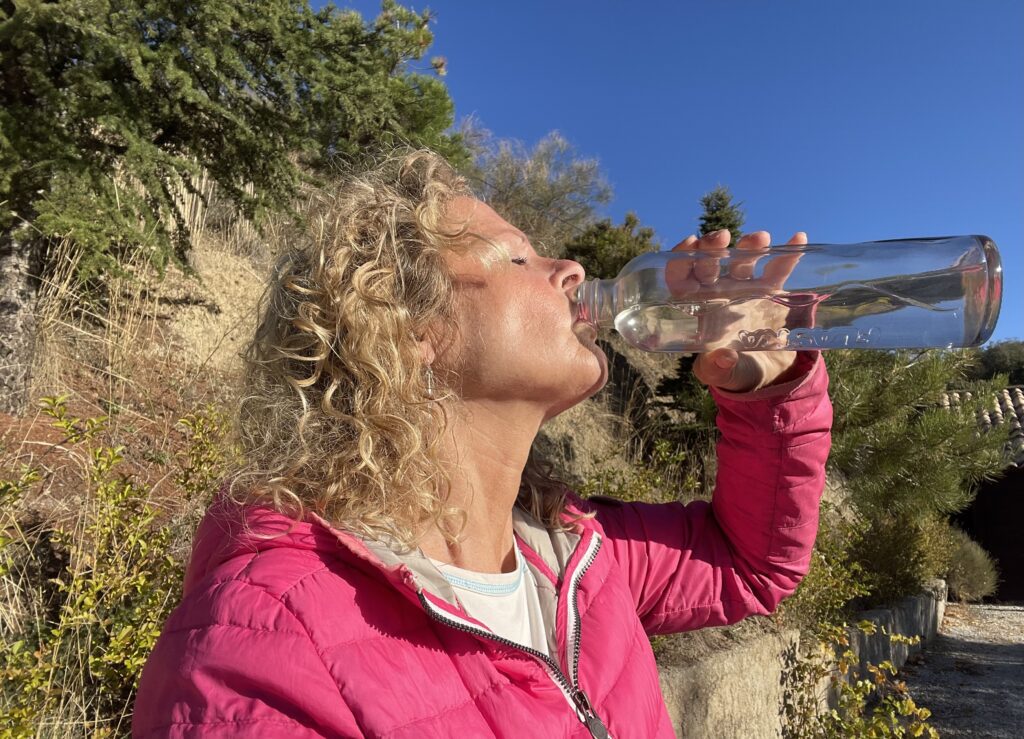
For this reason, carrying a small flask to capture your tears can be a supportive practice. It allows you to consciously return tears to the body by drinking them or adding them to water during personal water rituals. In this way, tears are not lost. They are honoured, returned, and integrated.
From Calcified Water Back to Flow
Grief that stays inside is unfinished.
When emotion is not expressed, the body’s water loses movement. It becomes dense. Pressurized.
This can be described as crystalline water that has become calcified. Water that is structured and ordered, but stuck, dense, and no longer able to flow with ease. Not literally stone, but water that has lost liquidity.
Crying is a phase change.
When grief becomes tears:
- Pressure releases
- Circulation restores
- Inner water returns to flow
This is why people feel relief after crying.
The story may still be there. But the water has changed state.
This is alchemy. Not symbolic, but embodied.
Adding Tears to Water
Across cultures, tears have been returned to water. In bowls. In rivers. In baths.
Adding tears to water energetically opens the water.
Not because the chemistry changes dramatically. But because the relationship has entered the field.
Tears are water that has passed through truth. When they are returned to water, a cycle closes.
The water is no longer neutral. It has witnessed something real.
This alters how the body interacts with that water.
What People Are Unaware Of
Most people think crying is a weakness. Or loss of control.
I believe this idea did not arise by accident. For a long time, crying has been framed as something to hide, suppress, or grow out of. We have been taught not to cry, not to show tears, and to move on quickly. This conditioning keeps us away from one of the body’s most direct healing processes.
When tears are suppressed, the body’s water remains dense and restricted. When crying is allowed, the body initiates its own restoration.
Tears are evidence that grief has moved. That the body was able to process what mattered.
This is not a belief. It is bodily intelligence.
Closing
Every tear is water that has completed grief.
When you cry, you are not falling apart. You are finishing something.
When tears return to water, the cycle completes.
This is how the body heals. Through water. Through movement. Through release.
Long before language tried to explain it, the body already knew.
A healed body radiates a different energy. This inner coherence shapes what you create, attract, and manifest in your outer world. When your water flows again, life responds differently.
What’s next?
Go to the FREE menu and check whether you want to learn more about water.
Do the quiz and find out what water flow type you are
Start clearing, cleaning and energising your water
Check out some of the webinars I gave
If you go to contact-page, you can schedule a free 15-minute call to find out how I can help you with advice about one of my coaching programs, a product in the shop or one of the water healing retreats and trips