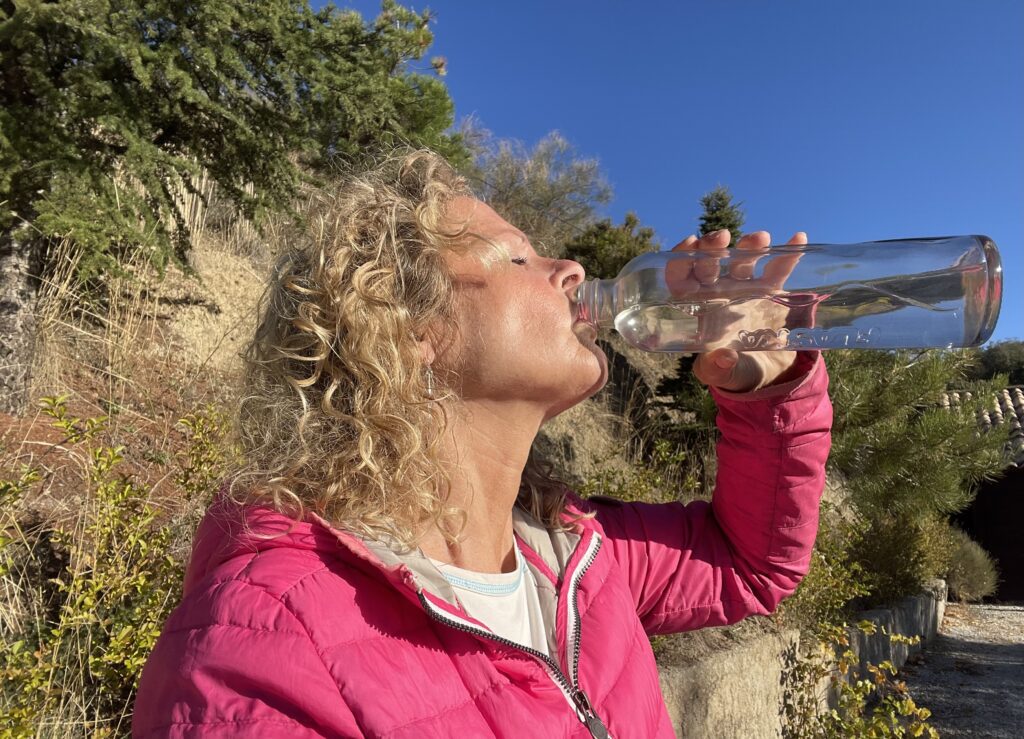
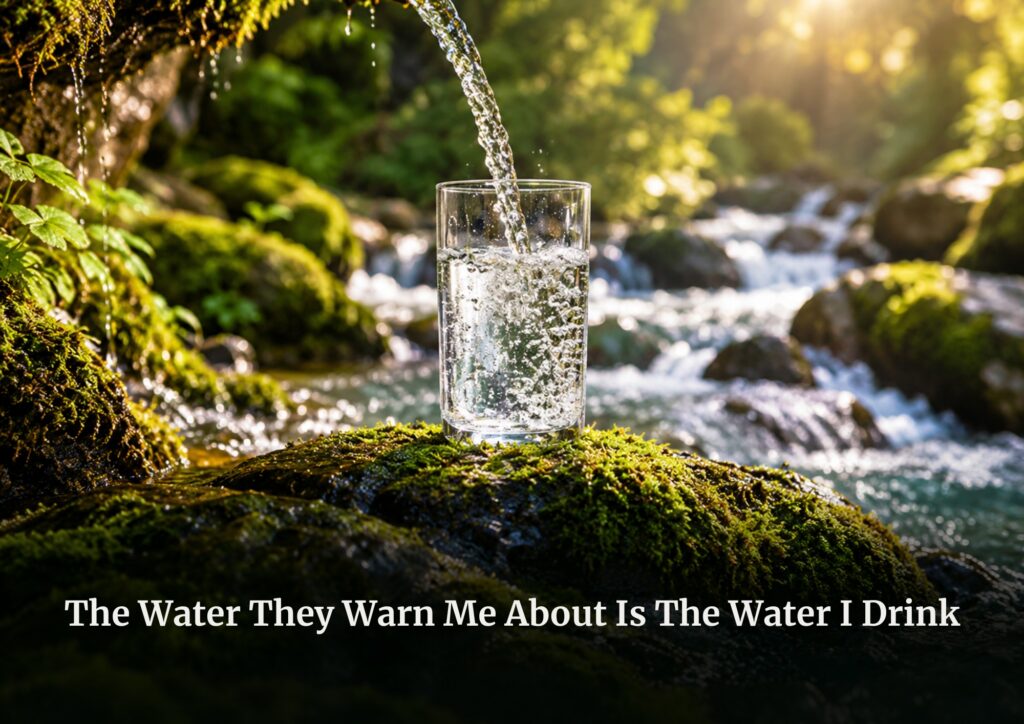
Natural drinking water has become one of the biggest questions in my life. Most people see a warning sign. I see an invitation. I drink water straight from nature, while I use bottled water for washing dishes and cooking. For nearly two years, I’ve turned conventional thinking about water upside down.
But how do I decide which water to trust? And what have I discovered that makes me question the water we’re told is safe?
Most people never think about water. I’ve made it the whole point.
Why I Started Questioning Natural Drinking Water
Most people use tap water or bottled water without giving it a second thought. It comes out of a tap, it comes in a bottle, and it goes down without another glance. They shower in it, drink it, and rarely wonder what is in it or how it affects the world around them.
I used to be the same. Now I’ve turned the whole thing upside down.
The Sign That Means “Come Drink Here”
When I’m camping, I look for places in nature where I can find fresh, flowing water.
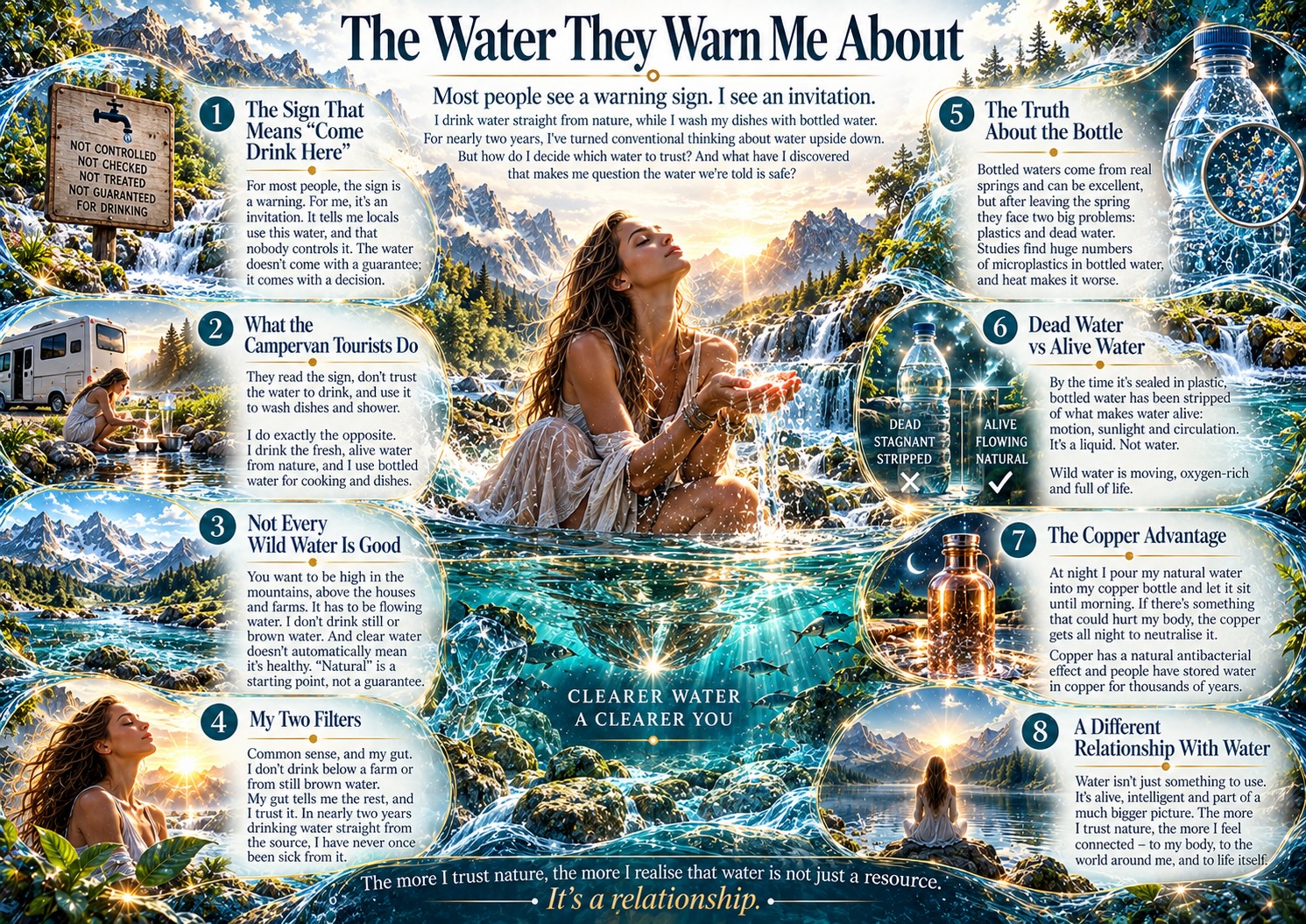
Usually, there’s a sign. It says the water has not been controlled, checked, treated, or guaranteed for drinking.
For most people, that sign is a warning.
For me, it is an invitation to look more closely.
And let’s be precise about the word controlled. It means nobody has confirmed the water is safe to drink. That does not automatically tell me what is in the water, good or bad. It means there is no guarantee, and the responsibility for making a decision remains with me.
Sometimes I see locals collecting water from these places. I notice the worn paths, the flattened ground, and the little clearings where people have stood for years. A fountain or a tap in a central square can also tell me that a water source is used by the community.
But I have learned that seeing other people collect water does not prove that it is safe. Water can look clear and still contain things we cannot see.
What the Campervan Tourists Do
The campervan tourists read the sign the way it is written. They don’t trust the water for drinking, so they use it to wash dishes or shower.
I have developed a very different personal routine.
I prefer to look for natural drinking water, while I buy bottled water from the shop to wash my dishes, boil my eggs, and cook.
And I never want to waste the water I have collected. If I have some left, I put it back in my drinking jar.
At night, I pour some into my copper bottle and let it sit until morning. It has become part of my personal ritual.
Copper has been studied for its antimicrobial properties, and copper vessels have a long history of use. However, storing water in copper is not a proven way to make untreated water safe to drink. It does not replace proper testing or treatment, and I would not want anyone to rely on it to remove harmful germs.
Not Every Wild Water Source Is Good
I have to be honest here, or this starts to sound like a religion.
Not every natural water source is good water.
There are things I pay attention to:
- I look at the surroundings. Farms, houses, roads, and other activity upstream can affect water quality.
- Brooks near villages and farms may receive wastewater or agricultural runoff.
- I pay attention to whether the water is flowing or still.
- When water runs brown or looks unusual, I leave it alone.
- And clear water does not automatically mean healthy water. Clear simply means you can see through it.
So no, “natural” is not a magic word. It is a starting point.
There is also an important safety point: harmful bacteria, viruses, and parasites cannot always be seen. The CDC guidance on treating water when hiking, camping, or travelling explains that even clear water from a mountain stream may be unsafe to drink without treatment. Boiling or an appropriate filtering and disinfection method may be needed. Chemical contamination requires different precautions.
My own observations are not a substitute for water testing.
My Two Filters: Common Sense and Intuition
So how do I decide what feels right to me?
Common sense, and my gut.
That’s how I approach my personal choices. Common sense tells me not to collect water from below a farm or from a questionable source. My intuition helps guide the rest of my decisions.
In all my time drinking water straight from the source, I have never once been sick from it. It has been nearly two years since I stopped drinking tap water, and during that time, I feel my intuition has grown massively.
I understand that a personal experience is not proof that a water source is safe for everyone. I can only speak about my own experience.
The Truth About Bottled Water
People often assume that all bottled water is the same. I don’t see it that way.
Water has what I like to think of as terroir. Every spring is different, and different bottled waters can have different mineral compositions. Some are naturally rich in certain minerals; others have a very different profile.
The differences can be measured. A study comparing the mineral content of tap and bottled water explored how their mineral compositions can vary.
The problem, for me, is not only where the water comes from. It is also what happens after it leaves the source.
Plastic and Microplastics in Bottled Water
One concern is plastic.
Research has detected microplastics and nanoplastics in bottled water. A Columbia University study on nanoplastics in bottled water reported an average of around 240,000 detectable plastic fragments per litre across the samples tested. Most of the detected particles were nanoplastics.
That is a striking finding. However, researchers are still studying what exposure to these particles means for human health. The study does not establish that every bottled water brand contains the same amount or that the detected particles have a proven health effect.
It does make me think more carefully about the water I buy and the containers I use.
What I Mean by “Dead Water”
I often describe bottled water as dead water. I am using that expression in my own personal and spiritual sense, not as a scientific classification.
For me, natural water represents movement, sunlight, circulation, and a connection with the environment. These are qualities I associate with water that is alive.
I know that this is how I experience and understand water. It is not a claim that bottled water chemically stops being water or that science has established a category called “dead water”.
Why I Don’t Use Washing Liquid
Why would I?
When I wash my dishes with bottled water, I first wipe away the grease with a tissue. I then use water for the rest of the cleaning.
This is simply the routine I have developed for myself. It is not a recommendation that everyone should stop using washing-up liquid or other appropriate cleaning products.
Why I Question Tap Water
In many places, drinking water is treated with chlorine or other disinfectants to control harmful germs. I understand why water treatment is used, but I also want to know more about the substances that may be present in the water reaching my tap.
There are other things I think about too: residues from medicines, agricultural chemicals, metals from old plumbing, PFAS, and microplastics.
These are not all the same kind of contaminant, and they cannot all be addressed by one treatment method. Their presence and levels depend on the water source, the surrounding environment, the treatment process, and the plumbing system.
I have also come across claims that chlorine or fluoride in drinking water calcifies the pineal gland, sometimes described as the third eye or our connection to consciousness. I cannot present those claims as established medical facts. I prefer to separate what I personally believe from what research has actually demonstrated.
For me, questioning tap water is about wanting more transparency and understanding what is in the water I drink, rather than assuming that every water supply is identical.
And Yes, Some Bottled Water Comes From Municipal Sources
This is something many people don’t realise.
Some bottled water does come from municipal sources—in other words, public drinking water or tap water. It may then be treated, filtered, or purified before being bottled.
The FDA’s guide to bottled water explains the different types of bottled water and confirms that some products originate from municipal supplies.
The FDA also explains that spring water has a specific definition: it must come from an underground formation from which water flows naturally to the surface, with collection subject to the requirements described in its guidance.
So the bottle on the shelf might contain water from a spring. Or it might contain treated water from a public supply.
That is why I like to look beyond the label.
PFAS Is a Concern for Natural Drinking Water Too
This is the uncomfortable part.
PFAS are a large group of manufactured chemicals that have been detected in water and the wider environment. Natural sources are not automatically protected from environmental contamination.
That includes the possibility of contamination from rain, surface water, and groundwater. But without testing a particular source, I cannot say whether it contains PFAS or how much.
I am not pretending that my choice of natural drinking water is automatically pure. I know that environmental contamination is a wider problem, and I want to be honest about that.
For me, the goal is to understand what I am drinking rather than assume that one type of water is perfect and another is always bad.
What “Alive” Actually Means to Me
This is where people sometimes switch off, so stay with me.
Water is H₂O, but the water we encounter in nature also contains dissolved minerals, gases, and other substances. It moves through landscapes, comes into contact with different materials, and changes with its environment.
I am fascinated by the work of people who have explored water from different perspectives.
Researchers such as Gerald Pollack have proposed ideas about a structured or “fourth phase” of water. Viktor Schauberger explored the movement of water and what he described as implosion. Masaru Emoto became known for photographs of ice crystals formed from water under different conditions.
These ideas have influenced how I think about water, although they are not all established scientific explanations or accepted scientific consensus.
For me, they encourage a deeper curiosity about something most of us take for granted.
You Are What You Drink
Water is a major component of the human body, and it plays an essential role in everyday bodily functions.
Sit with that for a second.
The quality of the water we drink matters. Minerals matter too, although our bodies obtain essential minerals from food as well as from drinking water. It is not accurate to say that water without minerals simply passes through the body doing nothing.
I believe it is worth paying attention to what we drink and understanding what we put into our bodies.
In my blog, The Soul’s Thirst for Water, I explain which minerals I add to one litre of water daily. Not to all the water I drink.
Since I wrote that blog, I’ve also added baking soda and Epsom salt to my personal routine. These are my own choices, not a recipe or recommendation for everyone. Anyone considering adding minerals or salts to drinking water should check that they are appropriate for their own circumstances.
You are what you drink. Not just a slogan, but a reminder to pay attention.
“But Isn’t Untreated Water Dangerous?”
I hear it every time.
And it is a fair question.
The honest answer is that untreated water can be dangerous. Natural water can contain harmful germs even when it looks clean, flows quickly, and comes from a remote location. A lack of visible pollution does not establish that it is safe.
The CDC’s advice on drinking water from natural sources recommends treating water from springs, rivers, lakes, and streams before drinking it. Boiling, or using an appropriate filtering and disinfection method, can help address germs. Some chemical contaminants require a different response.
These are important distinctions, and I don’t want my personal story to give anyone the impression that intuition, a copper bottle, or a warning sign can replace proper water-safety measures.
“But the sign says NOT CONTROLLED!”
Exactly. It tells me that the water has not been verified or guaranteed as drinking water. I see it as a reason to pay attention, not as proof that it is safe.
“Bottled water is safer.”
Not every bottle has the same source, composition, or packaging. I want to know more about what I am buying.
“Tap water is regulated.”
Regulation and treatment are important, but I still want to understand what is being tested, what the standards cover, and what is present in the water reaching my home.
The Point
I don’t automatically trust the tap. I don’t automatically trust the bottle either.
I am drawn to natural drinking water because of my personal connection with nature and the way I have come to experience water.
But I also recognise that natural does not automatically mean safe, and that trust alone cannot tell me what is in a glass of water.
For me, the journey is about becoming more conscious of water, asking questions, and making informed choices.
One More Thing
I’m writing a book about water. It’s coming out soon, and if any of this spoke to you, you’ll want to hear about it.
It will be an A-to-Z exploration of water, both outside and inside you.
You can join the waiting list here:
Join the Water Book Waiting List
Sources and Further Reading
- Study comparing the mineral content of tap and bottled water
- Columbia University study on nanoplastics in bottled water
- Snopes fact-check on whether Aquafina comes from tap water
- FDA guide to bottled water and its different sources
- CDC guidance on treating water when hiking, camping, or travelling
- CDC advice on preventing Giardia infection from untreated water