
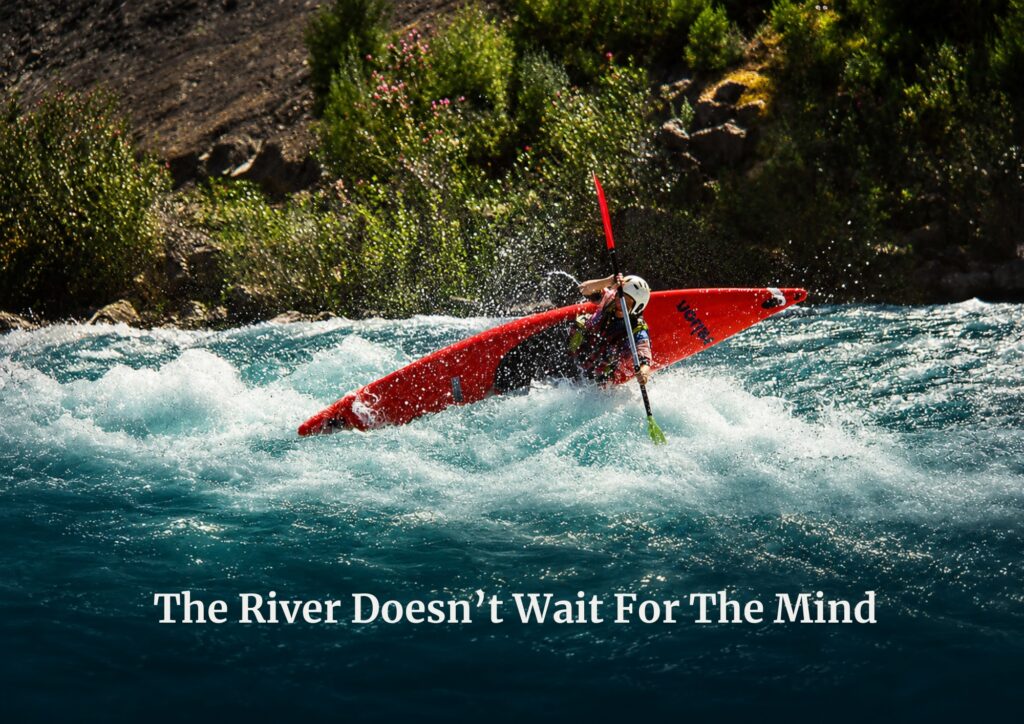
Surrendering the thinking mind can open the door to a deeper way of experiencing life. Through my whitewater experiences, I discovered that the constant need to analyse, anticipate and control can keep us from something far more powerful: intuition, presence and the intelligence of the body.
For everyone who spends most of their life inside their mind, analysing, anticipating and trying to control what comes next. What if the very control you seek is keeping you from your greatest power?
As a whitewater kayaker, I had moments when I experienced something I could never have reached through thinking.
Before entering a dangerous rapid, I would study it from the riverbank, observing the currents, rocks, waves and possible routes through the rushing Water. From there, I could see the bigger picture and prepare for what was coming.
But the moment I entered the river, everything changed.
Sitting low in my kayak, the Water looked completely different. Waves that seemed manageable from the bank suddenly towered above me. The currents were stronger than they looked, and everything rushed by at tremendous speed.
There was no time to think about every movement. The thinking mind was simply too slow to keep up with what was happening.
And that was precisely when something extraordinary happened. My mind became silent while my awareness sharpened. I felt the slightest shift in the kayak, the pressure against my paddle, and the Water moving beneath me. My body responded before I could think.
I wasn’t analysing the river anymore. I was moving with it, and I didn’t have to tell my body what to do. It already knew.
Years later, I recognised that what happened on the river wasn’t only about kayaking. It revealed something about the way we navigate life itself.
1. The map was never the river
As a former whitewater kayaking champion, I experienced the difference between observing something and being part of it.
From the bank, I could study the Water and prepare. But once inside the rapid, I was no longer observing a moving system from the outside. I had become part of it.
Every current influenced my position, and every movement of my body changed how the kayak responded. The river was no longer something I could simply analyse. I had to experience it.
My mind could help me recognise obstacles and plan routes, but it couldn’t process the constant stream of information quickly enough to direct every movement.
The map was never the river.
And thinking about an experience was never the same as being inside it.
2. The body responds before the mind understands
I remember moments when my kayak would suddenly tip sideways. The current caught the edge of the boat, my balance shifted, and within a fraction of a second, I was heading towards the Water.
I didn’t consciously decide to plant my paddle. My body had already responded. The paddle touched the Water, my hips corrected the movement, and the kayak came back underneath me.
Only afterwards did my conscious mind register what had happened.
The body had already sensed and responded to information before the thinking mind could translate it into conscious thought. The mind came afterwards, explaining an experience that had already taken place.
Years of experience had developed that responsiveness, but in the moment itself, there was no analysis or weighing of options. Just awareness and movement.
What I loved most about whitewater kayaking was the absolute presence it demanded. The future was one stroke ahead. The past was one stroke behind. The only moment that mattered was the stroke I was making.
The noise of the mind disappeared. Only the Water, my body, and my complete presence within the movement remained.
And with that presence came freedom.
I couldn’t control the river, yet I could move with its power instead of fighting it. The moment I stopped trying to control every movement with my mind, I accessed a greater power within myself.
Surrendering to the movement didn’t make me powerless. It made me capable of far more than conscious thinking could achieve.
3. Why is this normal in sport but not in life?
We accept this intelligence almost without question in sport. Nobody expects an experienced kayaker to consciously analyse every paddle stroke or a surfer to calculate every adjustment while riding a wave.
We understand that the body responds faster than conscious thought. We admire this ability and call it flow, being one with nature, one with the elements.
And then we return to everyday life and try to think our way through everything.
We rehearse conversations, imagine responses, and analyse decisions, believing that preparation will give us control over what comes next.
But life doesn’t follow our scripts. The moment someone responds differently than expected, everything changes. Suddenly, we are navigating something we couldn’t predict.
Just like the river.
While our minds calculate, our bodies may already sense subtle changes in someone’s voice, the atmosphere of a room, or something that doesn’t match the words being spoken.
Awareness receives information before it becomes a conscious thought. The body senses and responds, while the mind attempts to translate those signals into something understandable.
The mind gets the summary. The body gets the signal.
By the time we have mentally explained what we sensed, that moment has already passed.
So why do we trust the body at forty kilometres an hour and distrust it at walking pace?
4. Why have we given the mind so much authority?
From childhood, many of us in Western society are taught to value thinking above feeling. Sit still. Think before you speak. Use your head. Explain yourself. Make rational decisions.
At school, we are rewarded for correct answers and clear reasoning. Later, professional life reinforces the same pattern through analysis, arguments and measurable outcomes.
But what happens when our deepest knowing cannot be explained?
We often dismiss it, question ourselves, or allow our minds to overrule what we already feel.
I believe this is one of the great disconnections of modern Western life. We have placed the thinking mind in authority over an intelligence that can perceive far more than thought alone.
The mind seeks certainty and predictable outcomes. Because life cannot provide those guarantees, it continually attempts to create control through more planning, analysis and thinking.
Yet the mind can only work with what it has translated into thoughts, memories and familiar patterns. It can describe past experiences and imagine future possibilities, but it cannot replace direct awareness.
We are trying to navigate a living reality with a map that can never contain the whole landscape.
The more desperately we try to control life through the mind, the further we move away from the intelligence that could give us the power we seek.
5. Intuition comes first
For me, the order is clear.
Intuition comes first. The mind follows.
The body perceives through sensation, movement and awareness, accessing a depth of knowing that conscious analysis cannot reproduce. Intuition doesn’t need an explanation before it can be recognised. It is often simply there: a knowing, a direction, a sense that something is aligned or out of place.
The mind comes afterwards, translating what has already been perceived into words, comparisons and explanations.
This is why I don’t believe the mind should determine our direction. Its perception is limited, and its processing is too slow to replace the intelligence already responding to life.
The mind has a practical function. It can prepare, gather information, organise possibilities and present options, just as it helped me scout a river before entering a rapid.
The mind can offer options. It does not decide.
When the mind takes control, we choose according to what appears logical, predictable or safe. Gradually, we lose contact with the deeper awareness available to us.
I don’t believe the answer is to think more cleverly. It is to restore intuition to its rightful place and allow the mind to serve rather than rule.
6. The power we discover through surrender
Water taught me something that extends far beyond physical movement.
When you enter a river, you enter a system that is already moving. The current doesn’t begin because you arrive, and the waves don’t form because you need them. The river doesn’t wait for your decisions.
You can fight that movement, exhausting yourself against something greater than your strength. Or you can surrender to it and discover how to use its power.
A current that appears to be an obstacle can carry you forward. An eddy can provide stillness within a powerful rapid, while a wave can offer energy you could never generate through paddling alone.
By surrendering the need to control the river, I gained a kind of control that fighting the Water could never have given me.
I could move with its power rather than exhaust my own, recognising possibilities that only became available when I stopped resisting.
The river was not separate from me. My movements influenced my position within the current, while the current influenced every movement I made. I was part of an ongoing interaction.
This has become one of the most important understandings in my work with Water and consciousness.
We are not standing outside life, directing it from a distance. We are already participating in it.
Yet we spend so much time trying to control life through our minds that we forget to feel the movement we belong to. We attempt to predict the future, prevent uncertainty and analyse the past, while life is happening now.
To surrender to this movement and let go of the controlling mind gives us real control and power, a kind the mind itself can never provide.
This is the paradox. We believe surrender means giving up our power, when it is precisely through surrender that a far greater power becomes available.
We have been searching for power through control, while the greater power becomes available through surrender.
7. Freedom begins when we let go
We have become so accustomed to asking the mind for answers that we rarely question whether it is the right place to look. We ask it to determine our direction, predict outcomes and protect us from experiences we cannot yet understand.
But how can we enter a greater awareness of life if we allow our direction to be determined by the very part of us that cannot perceive its fullness?
We cannot analyse our way into complete presence, and we cannot control our way into freedom.
We have to surrender.
Not our awareness, responsibility or power, but the belief that the thinking mind must control our lives. We release the constant need to predict, justify and mentally direct every movement.
The freedom I experienced in whitewater didn’t come from knowing what would happen. It came from being fully present with what was happening, without a mind trying to control the experience.
There was only awareness, trust and participation.
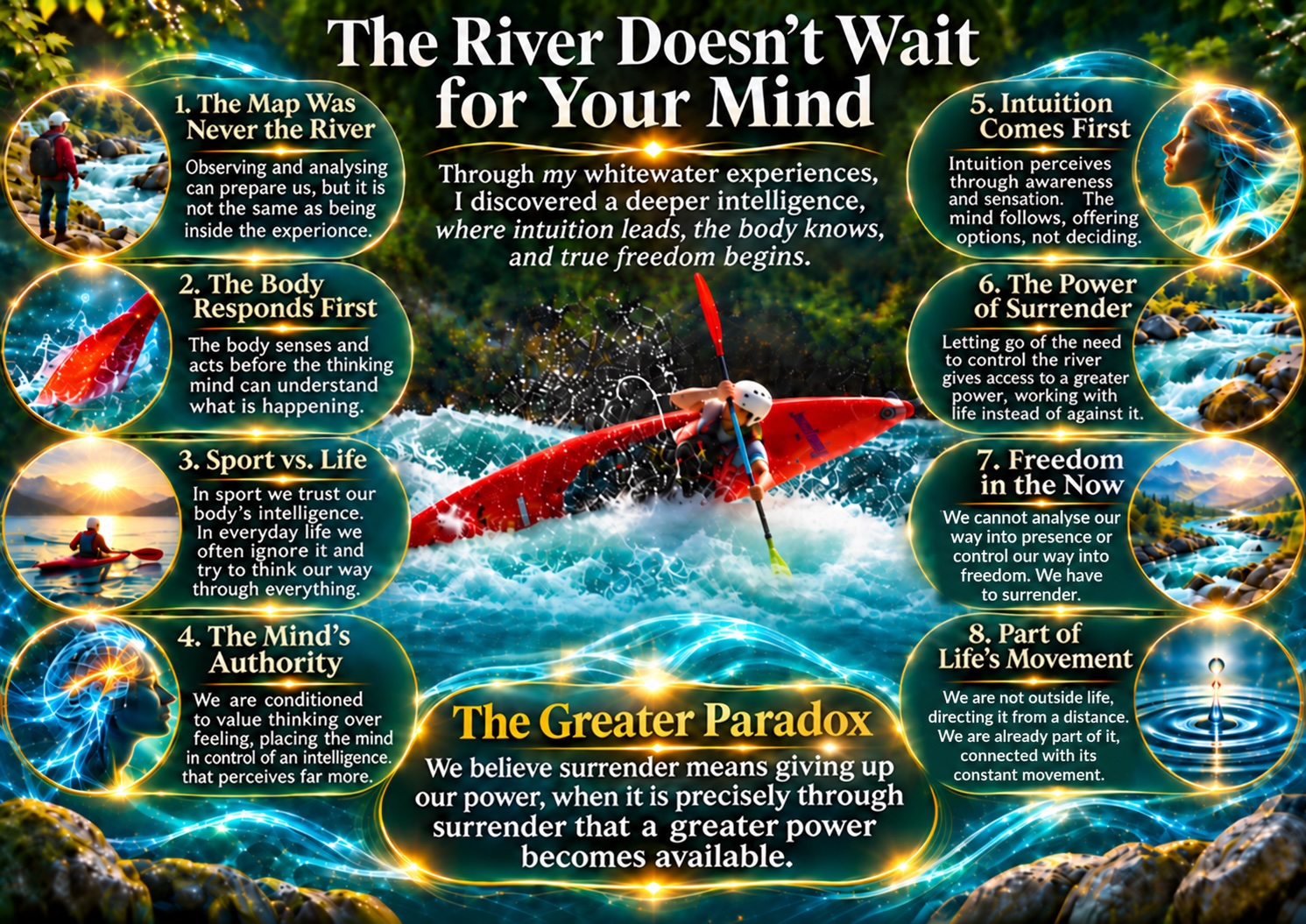
Freedom lies in being in the now. It is where flow happens.
And in that freedom, we discover the very power the mind has been desperately trying to achieve: the ability to navigate life with clarity and confidence, not by controlling it from the outside, but by becoming fully conscious participants within it.
We are not here to stand on the bank forever, studying the current and predicting every movement. We are here to enter the river, experience life and trust the intelligence that connects us to its movement.
And remember, you have an inner river. You are mostly Water. This is not a metaphor.
Because life is not something we control from the outside with our minds.
It is something we are already part of.
And when we surrender the mind’s need to control it, we discover a power and freedom we could never have reached through thinking.
The river doesn’t wait for the mind to understand.
It simply flows.