
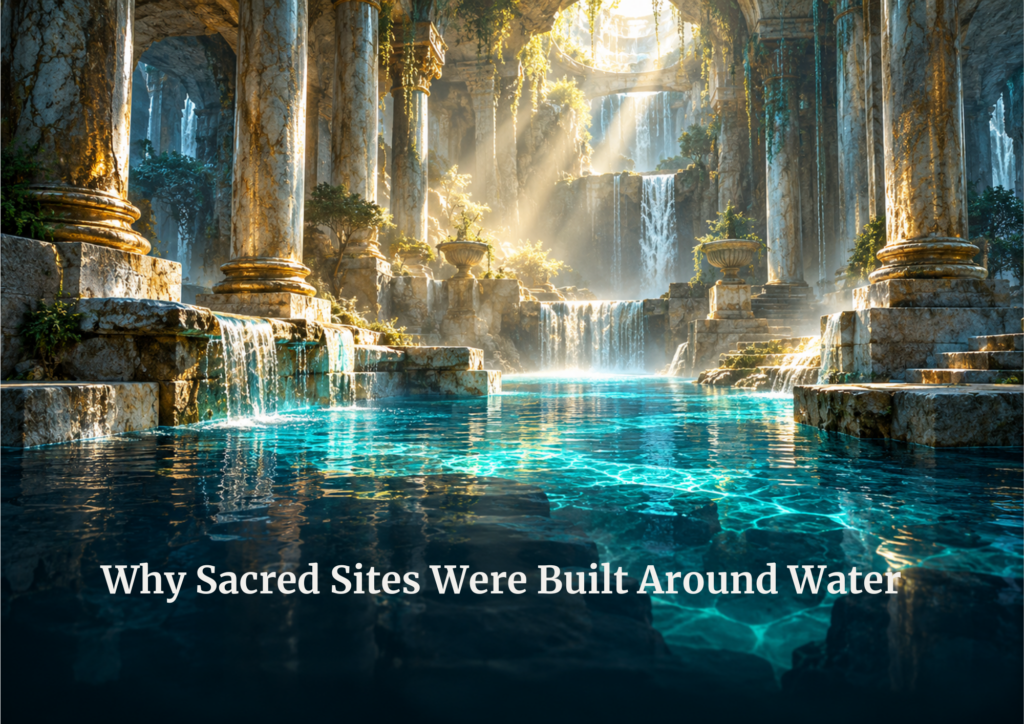
Why Sacred Sites Were Built Around Water
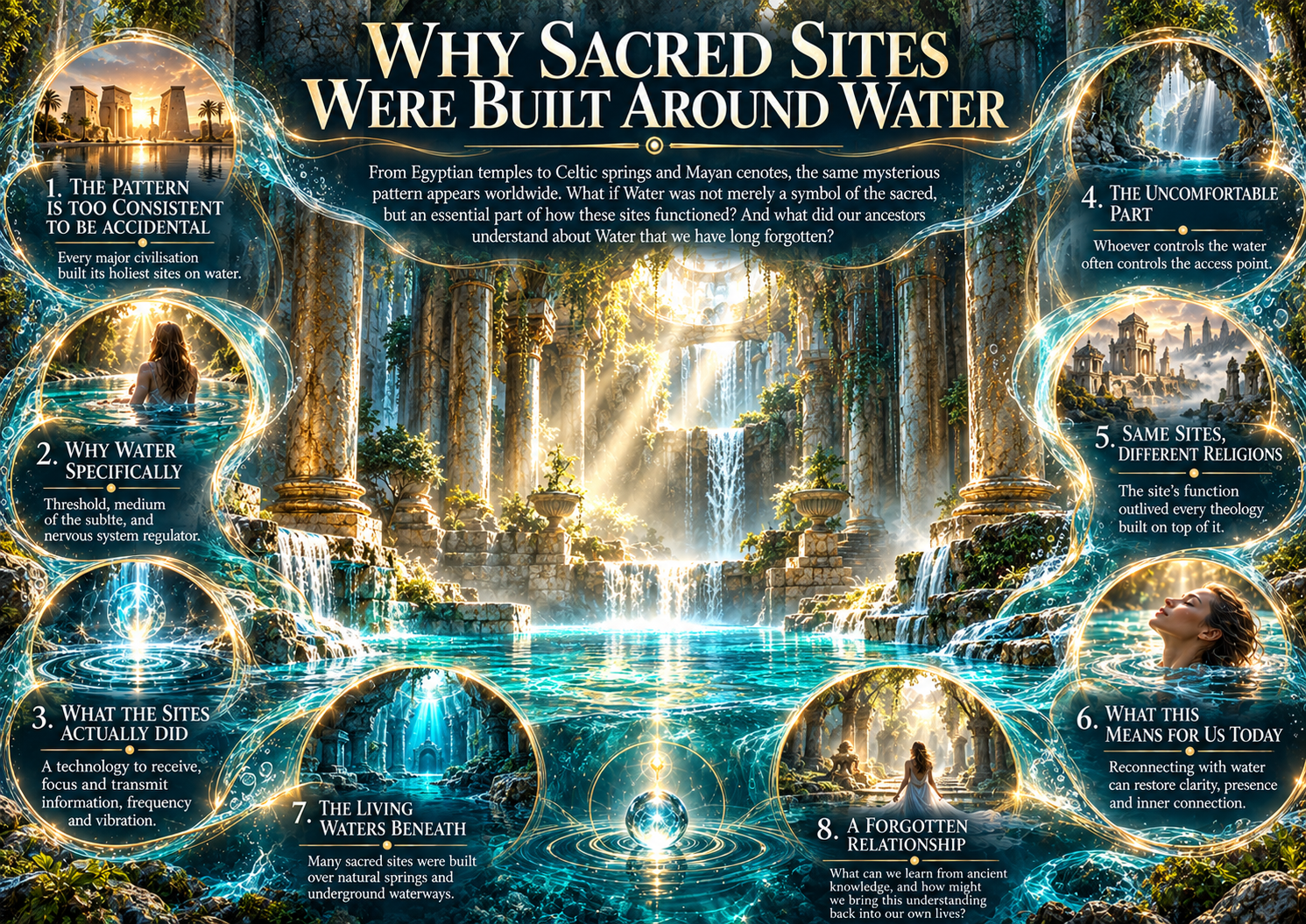
Why did ancient civilisations build their most sacred temples around Water? From Egyptian temples to Celtic springs and Mayan cenotes, the connection between sacred sites and water appears across the world. What if Water was not merely a symbol of the sacred, but an essential part of how these sites functioned? And what did our ancestors understand about Water that we have long forgotten? Perhaps a greater mystery lies not in the temples themselves, but in the Water beneath them.
The Forgotten Purpose of Water at Sacred Sites
Have you ever noticed that wherever our ancestors built their most sacred structures, water was always there? Not nearby by accident, but placed at the very centre, woven into the design, guarded, worshipped, and used. Across every continent, every era, every religion, the holiest ground was always water ground.
That is not decoration. That is not coincidence. Water was placed at the centre of sacred architecture because it was understood as the mechanism, not the symbol, of contact between worlds.
When I say mechanism, I mean something specific: water was treated as a functioning interface, a physical medium through which something was transmitted or received. Not a metaphor for the divine. A working part of the apparatus.
And what was transmitted? Information. Frequency. Vibration. The subtle signals that connect the visible world to the invisible one. Water carried them. The site received them. The ritual opened the channel. This is why water sat at the centre, not to look beautiful, but to function.
The Pattern Is Too Consistent to Be Accidental
The connection between sacred sites and water can be explored through examples from major civilisations around the world:
- Egypt — Karnak and the Nile, temples with sacred lakes for purification.
- Greece — Delphi, Dodona, and the oracle springs; the Pythia drank and bathed before prophesying.
- Rome — The Vestals guarded the sacred spring of Juturna in the Forum.
- India — Varanasi on the Ganges, temples with tanks (kunds) for ritual immersion.
- China — Feng shui placed water as the primary determinant of site selection.
- Judaism — The Temple Mount sat above the Gihon spring, the city’s only water source.
- Islam — The Zamzam well, and ritual washing before every prayer.
- Celtic and Nordic — Holy wells, springs, and bogs as thresholds to the Otherworld.
- Mesoamerica — Cenotes as literal doorways to the underworld.
Different continents. Different eras. Same placement logic.
Yes, water was practical. But practicality alone doesn’t explain why the holiest structure, not the market, not the barracks, was placed on top of, or next to, the water. Or why the same spot stayed sacred for three thousand years across various religions. Practicality explains the city. It doesn’t explain the temple.
Why Water Specifically?
Three reasons keep surfacing across traditions that connect sacred sites and water.
1. Water as a Threshold
Water appears at every transition: birth, initiation, marriage, death, entry into the temple. It doesn’t symbolize the crossing. It creates the conditions for it. Contact with water shifts awareness out of fixed identity and into sensation.
You can feel this yourself. Step into a cold river and the thinking mind goes quiet for a moment. Stand under a waterfall and something in the chest loosens. Sit beside still water and the breath slows without effort. That shift, from head to body, from fixed to fluid, is the threshold. Water doesn’t teach it. Water triggers it. And the ancients built their temples exactly where that trigger was strongest.
2. Water as the Medium of the Subtle
Ancient cultures treated water as the physical interface between the visible and invisible. Sound enters water and becomes light. Word enters water and becomes form. This is not just poetry; water responds to vibration in ways we can measure. Sound changes its structure. Intention changes its crystalline form. Frequency moves through it and is carried. The site was chosen because water was already a living conduit; the temple was built around the conduit, not the other way around.
3. Water as a Nervous System Regulator
Still and gently moving water entrains the body. It slows breath, stabilises emotion, softens thought. Part of this is chemistry: moving and falling water releases negative ions into the air, and negative ions have a measurable calming effect on the nervous system. They reduce stress, lift mood, and help the body settle into a regulated state.
Palace ponds at eye level. Bridges that force a pause. Fountains as hygiene for the nervous system. Governance and revelation both began in physiology; a regulated body perceives more clearly.
What the Sites Actually Did
The sacred site was a technology, not a monument:
- The spring or well was the power source.
- The temple structure focused and directed it.
- The ritual was the operating procedure.
- The priest or oracle was the trained operator.
This is why the same sites were used for thousands of years across completely different religions. The Nile temple became a church, then a mosque. The Celtic well became a Christian shrine. The site’s function outlived every theology built on top of it.
The Uncomfortable Part
If water is a conduit and sacred sites are amplifiers, then whoever controls the water controls the access point. That is why later institutions kept the sites and the water rituals but often redirected their meaning, turning a direct experiential technology into a mediated one that required an intermediary. Or they turned the site into a burial place only, burying the living function with the dead.
The water didn’t change. The instruction manual did.
Explore More About Water
The connection between sacred sites and water is one part of a much larger exploration of our relationship with Water. You can also read The Ocean Is Still Living Inside of You to continue exploring the connection between water, nature, and our inner world.