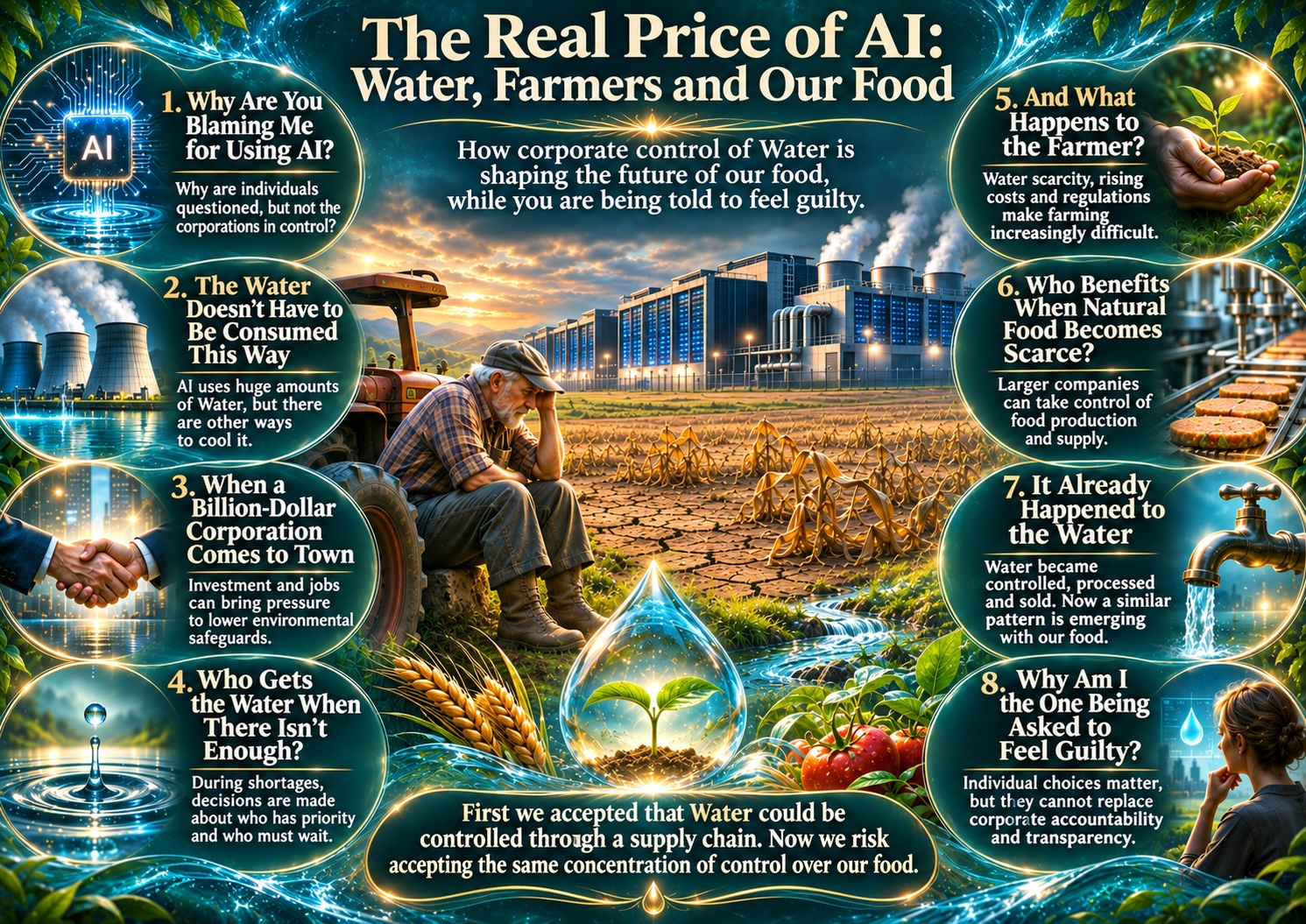
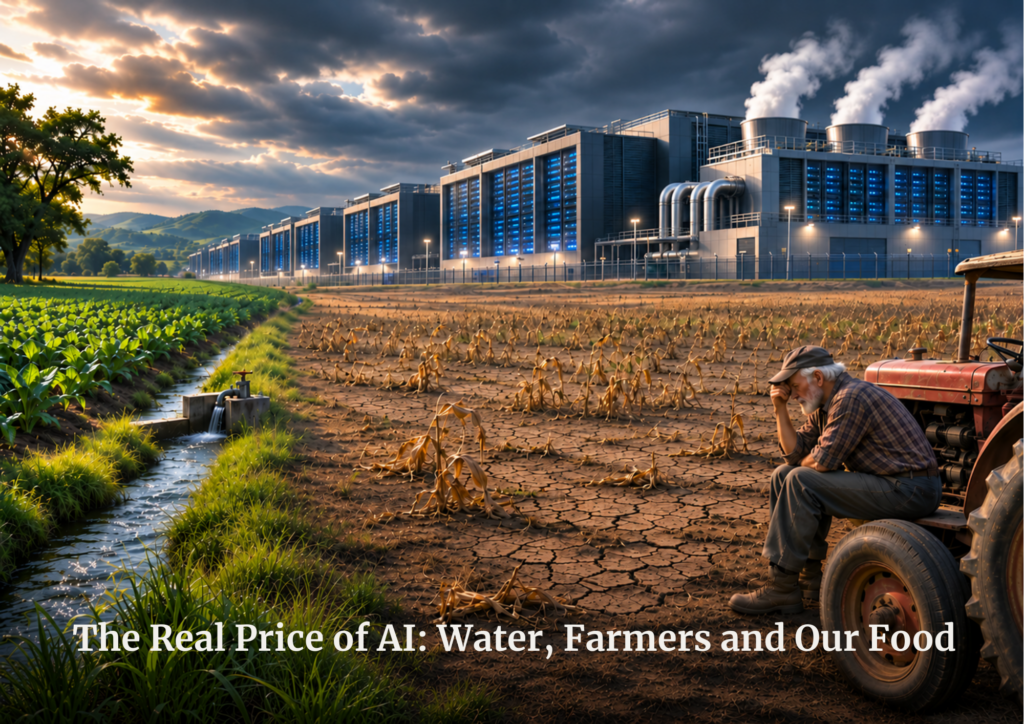
How corporate control of Water is shaping the future of our food, while you are being told to feel guilty.
AI data centre water use is a question several people have asked me recently. How can I work so closely with Water, speak about its importance to life, and still use artificial intelligence?
Do I know how much Water AI requires?
Yes, I do. And I think the question deserves an answer.
But rather than simply discussing Water consciousness, I want to look at something happening in the world around us. Something that concerns me deeply.
The more I investigate how Water is being used, controlled and allocated, the more I recognise a pattern that extends far beyond Water itself. And I believe we need to become aware of it, because the consequences may reach far beyond what most people currently understand.
1. Why Are You Blaming Me for Using AI?
People have asked me how I can work so closely with Water, speak about its importance to life, and still use artificial intelligence.
Do you know how much Water AI consumes?
Yes. I do. And the question deserves an answer. But I think we are asking the wrong people.
Why are we pointing fingers at individuals using technology instead of questioning the billion-dollar corporations deciding how that technology operates? Why are we discussing the environmental responsibility of an AI user while overlooking the companies choosing how to cool their enormous data centres?
And why are we so easily persuaded to carry responsibility for decisions we were never invited to make?
The more I explore this subject, the more I recognise a much larger pattern. One that goes far beyond AI.
What has already happened to Water may now be happening to our food. And I believe we need to understand the connection.
2. AI Data Centre Water Use Doesn’t Have to Be This Way
AI requires enormous computing power. Servers generate heat and must be cooled continuously. Some data centres use evaporative cooling, where Water absorbs heat and evaporates into the atmosphere. Others use different cooling systems, depending on their design, location and operating conditions.
The Water isn’t destroyed. It remains part of Earth’s Water cycle, but when Water is consumed rather than discharged, it is no longer immediately available to the local community, aquifer or ecosystem from which it was withdrawn.
The quantities can be substantial.
According to Google’s 2025 Environmental Report, its data centres withdrew approximately 9.866 billion gallons of Water in 2024. Of that amount, approximately 7.787 billion gallons were reported as consumed rather than discharged. That’s almost 79% of the Water withdrawn by Google’s data centres.
These figures describe Google’s data centres as a whole, not AI alone or the Water used by an individual AI query. Nevertheless, they demonstrate the scale of the infrastructure behind our digital services.
You can explore the figures in Google’s 2025 Environmental Report.
And here is what I find particularly interesting.
There are different ways to cool data centres.
Closed-loop systems, direct-to-chip cooling, immersion cooling, dry cooling and heat recovery are among the approaches that can be considered when designing data-centre infrastructure.
They are not all suitable for every facility. Some require additional electricity or investment, and their total environmental impact depends on the design and location. But that is precisely why these decisions deserve scrutiny.
A 2025 study by Lawrence Berkeley National Laboratory examined the factors influencing data centre water consumption. It found that water use per computing workload could vary by more than 10,000 times, depending on factors including server efficiency, electricity sources, workload efficiency, cooling systems and infrastructure.
In other words, AI data centre water use is not simply an unavoidable consequence of using technology. It is also influenced by choices made long before anyone types a question into a chatbot.
You can read the research here: The Water Use of Data Center Workloads – Lawrence Berkeley National Laboratory.
So why is the conversation focused so heavily on the person asking the question rather than the corporation designing the infrastructure?
3. When a Billion-Dollar Corporation Comes to Town
Imagine a multinational technology company approaching a municipality. It offers investment, employment, economic development and the prestige of attracting a major international business.
For politicians, this can look like a tremendous opportunity. But what happens behind the negotiating table?
On one side sits a corporation with enormous financial resources, specialised engineers, environmental consultants and experienced lawyers. On the other sits a municipality whose officials may have limited experience evaluating industrial cooling systems, long-term Water requirements or future drought scenarios.
Who has the stronger negotiating position? And what happens when a municipality demands more expensive environmental safeguards?
The company can potentially take its investment somewhere else. Another province. Another country. Another municipality eager for development.
That possibility alone creates pressure.
Politicians don’t necessarily need to be corrupt for this system to work. They may genuinely believe they are making the best decision for their communities. But when companies can negotiate across borders and communities compete for their investment, environmental protection can become a bargaining chip.
The Netherlands provides an interesting example.
In March 2021, Dutch news organisation NOS reported concerns raised by provincial documents about the potential impact of data-centre expansion in Noord-Holland on drinking-water availability during extreme weather conditions.
However, the story was disputed. The province said the research sample was too small to support its conclusions, and the Dutch Datacenter Association also disputed the reported consumption figures.
This distinction matters. The concerns were raised, but the reported shortage was not established as a certainty.
You can read the NOS report about data centres and drinking-water concerns in Noord-Holland.
More recently, the Waterbank Agriport project in Hollands Kroon offers an interesting example of an alternative approach.
Officially opened on 11 September 2025, the Waterbank was designed to store approximately 500 million litres of rainwater underground for reuse by greenhouse growers and nearby data centres. This helps reduce dependence on drinking water.
The municipality also explains that the data centres in Hollands Kroon mainly use air cooling, with additional cooling water required on particularly hot days. That water is reused several times. It also states that households receive priority over industrial users when PWN water is supplied.
The municipality’s explanation and the Waterbank project show that infrastructure choices and alternative water sources matter.
You can read more here:
But why should communities have to keep questioning these developments before Water-efficient alternatives become a central part of the conversation?
Farmers depend on Water for their livelihoods. They cannot afford to discover that their Water security is under pressure only after major industrial developments have been approved.
Why shouldn’t the most Water-efficient feasible systems be considered from the very beginning? Why should local communities have to raise the alarm before preventive measures receive serious attention?
Shouldn’t protecting the Water supply come before approving industries that depend on it?
4. Who Gets the Water When There Isn’t Enough?
This is where the story becomes more complicated.
Water scarcity is not simply about how much Water exists. It is also about who has access to it, who controls the infrastructure, and who has the legal and financial power to secure a supply.
In the Netherlands, Water allocation during shortages follows an official priority system known as the verdringingsreeks.
It establishes a legal priority order for distributing available Water when there is a shortage or an impending shortage.
Safety and the prevention of irreversible damage to nature receive the highest priority. Essential utilities, including drinking-water supply and energy security, receive the next priority. Other uses are assessed within further categories, including certain high-value uses and wider economic interests.
The exact classification of agricultural and industrial uses matters. They do not all automatically receive the same priority, and decisions can depend on the applicable regional rules.
You can read the official explanation here: The Dutch Water Priority System – Verdringingsreeks.
Now consider a data centre requiring reliable cooling every hour of every day.
What commitments have been made to secure that supply? What happens during prolonged drought? Can a municipality reduce deliveries? Under what circumstances? Who carries the financial consequences?
And how do contracts interact with the legal rules governing Water allocation?
These are questions that should be answered publicly before construction begins.
Because Water agreements signed during abundance may become far more consequential during scarcity.
And while we are debating our personal AI use, how many of us have actually seen the Water agreements behind the infrastructure?
5. And What Happens to the Farmer?
This is where my concerns about Water connect directly to our food.
A farmer cannot simply move production to another country overnight. The land is where it is. The soil has been cultivated, sometimes for generations. The crops depend on the local climate, ecosystem and Water supply.
When Water becomes scarce or expensive, farmers face consequences that cannot always be solved by increasing efficiency.
Crops fail. Yields decline. Costs increase. Some farms become economically unviable.
And the problem is not limited to Water.
Farmers are already facing increasing pressure from land prices, energy costs, regulations, large food buyers and industrial competition.
Meanwhile, we hear endless discussions about the environmental impact of livestock, particularly cattle and methane. There are legitimate environmental questions about agriculture. But why does so much public discussion focus on what farmers must change, while the wider systems shaping their possibilities receive less attention?
A farmer may be expected to produce affordable food, protect biodiversity, reduce emissions, preserve soil health and use less Water, all while competing with enormous industrial operations.
At what point do we stop blaming the farmer and examine the conditions under which farming has become increasingly difficult?
And what happens when those conditions push smaller producers out?
6. Who Benefits When Natural Food Becomes Scarce?
This is the connection I find most troubling.
When smaller farms disappear, food production does not simply stop. Production shifts.
Larger companies, with greater access to capital, technology, processing facilities and distribution networks, may be better equipped to absorb rising costs and disruption. They can consolidate land, increase industrial production, develop alternatives and expand their market position.
Not every large producer uses chemical-intensive farming, and small farms are not automatically environmentally sustainable. The issue is more fundamental.
Who controls the production of our food, and how much choice will remain when that control becomes concentrated?
We are already surrounded by highly processed products, industrial ingredients, patented technologies and increasingly complex supply chains.
At the same time, words like natural, sustainable and regenerative have become powerful marketing tools. But a label doesn’t necessarily tell us how food was grown, what happened to the soil, or how much control farmers retain over their own production.
And the question I cannot ignore is this:
If Water access becomes increasingly controlled, and independent farming becomes progressively more difficult, who will supply our food? Will we still have access to locally grown food from living, healthy soil?
Or will we become increasingly dependent on industrial systems that decide what is produced, how it is produced, and what reaches our plates?
I am not claiming that every data centre is deliberately being built to eliminate farmers. But I am questioning a system in which the same economic pressures can strengthen corporate control over one essential resource after another.
The result can be greater concentration of power, whether or not every participant intended that outcome.
7. It Already Happened to the Water
Think about how we relate to Water today.
It falls from the sky. It flows through rivers, springs and underground aquifers. It sustains every living system on Earth.
Yet access to Water has increasingly become dependent on infrastructure, ownership, treatment, permits, distribution networks and payment. We have become accustomed to buying something that nature provides through an interconnected living cycle.
And what reaches our taps is no longer the Water as it existed in nature. It has undergone treatment, processing and distribution.
I have written extensively about this journey and why I question the health of our tap Water in my earlier article, When Water Went Underground, So Did We.
But now I see a similar transformation unfolding around our food.
Food that once came from living soil, sunlight, Water and the work of farmers is increasingly competing with industrially manufactured and highly processed alternatives.
We are told these products are nutritious, safe, sustainable and sometimes even better for us. But I question whether manufactured food can truly replace what grows naturally in healthy, living soil.
And here is what concerns me most.
The battle over Water may have consequences far beyond Water itself. It could gradually make natural food production impossible for many farmers.
When farmers lose access to affordable Water, they lose the ability to grow food. When farms disappear, we lose more than agricultural businesses. We lose knowledge, independence, local production and the freedom to choose how our food is grown.
And if enough farmers disappear, what will remain?
We could find ourselves increasingly dependent on industrially produced food, with corporations deciding not only what is available, but also what we are told is healthy.
I have seen what happened when Water became something to be controlled, processed and sold. I do not want to watch the same thing happen to our food.
First we accepted that Water could be controlled through a supply chain. Now we risk accepting the same concentration of control over our food.
And perhaps the most effective part of this transformation is that we are encouraged to argue among ourselves while it happens.
8. Why Am I the One Being Asked to Feel Guilty?
So, returning to the original question: Why do I use AI when data centres consume so much Water?
Because I believe the responsibility for how a technology is built and operated must be examined at the level where those decisions are made.
That doesn’t mean individual choices have no consequences. It means individual responsibility cannot replace corporate accountability.
If a billion-dollar corporation can invest in enormous computing facilities, it can also be expected to demonstrate why its cooling system is environmentally appropriate.
If a municipality approves a facility requiring substantial Water resources, its officials should understand the technologies available, the potential risks and the long-term consequences.
If contracts affect a community’s future access to Water, those agreements deserve transparency and public scrutiny. And if farmers are expected to make increasingly difficult sacrifices for the environment, the same scrutiny should apply to the corporations competing for essential resources.
I don’t want a world in which we stop using technology. I want a world in which technological progress is not automatically granted priority over the living systems that sustain us.
And I certainly don’t want responsibility for these decisions quietly transferred to the people who had no influence over them.
Perhaps the next time someone asks how much Water my AI question consumed, we should ask something much bigger.
Who decided how that Water would be used? Who benefits from that decision? Who carries the consequences?
And, most importantly:
If we allow the same pattern to continue with our food, what will be left for us to choose?
The Water has already shown us how this works. We should pay attention before the same thing happens to our food.
If you want to know more about water, sign up for the waiting list of my upcoming book about you and water here: